
Tactile Map Production Techniques

Research and practice in tactile mapping shows that the production technique is one of the key factors determining the final quality, legibility, and usability of tactile maps. A tactile map is not only a cartographic design transferred onto a physical medium. It is a multisensory product whose effectiveness depends on the proper combination of content selection, symbol design, generalization, material properties, printing parameters, and post-processing. Tactile maps must be designed with the perceptual needs of people with visual impairments in mind. Wabiński, Mościcka, and Touya (2022), in their review of tactile map design guidelines and best practices, underline the importance of standardizing design rules while also adapting them to the intended use of the map and the production method. This is particularly important because the same cartographic symbol may be perceived differently depending on whether it is produced using swell paper, thermoforming, 3D printing, UV printing, or another technique. Traditional tactile map production has long relied on manual techniques, thermoforming, swell paper, and braille printers. Manual techniques remain important in educational contexts because they allow teachers and designers to create individualized tactile materials using accessible objects and textures. As discussed by de Sena and do Carmo (2025), such approaches can be especially valuable in geography education, where tactile materials support spatial understanding and active learning. However, manual methods are labour-intensive, difficult to reproduce consistently, and less suitable for larger production runs.
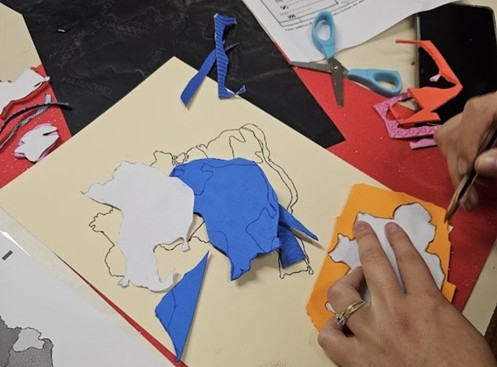
Figure 1. Manual technique for producing tactile maps.
Thermoforming has been widely used for the serial production of tactile maps and atlases. Its main advantage is the possibility of producing durable and repeatable copies once a matrix has been prepared. However, the method requires specialized equipment and is economically justified mainly when multiple copies of the same material are needed. Swell paper, in contrast, is relatively inexpensive and easy to use, including by people with visual impairments. It is useful for simple tactile graphics and educational materials, but it offers limited control over height differentiation and contour sharpness (Hashimoto and Watanabe, 2016).
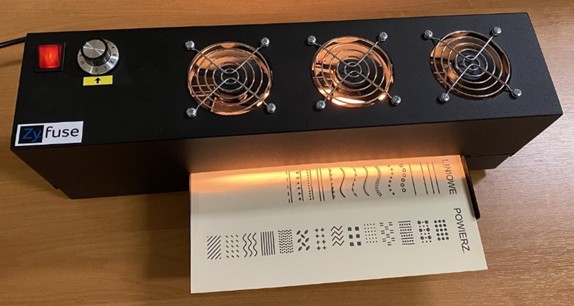
Figure 2. Swell paper being heated in a fuser.
Contemporary production techniques have significantly expanded the possibilities of tactile mapping. Additive manufacturing techniques, especially 3D printing, make it possible to transform a digital cartographic model into a physical tactile map with repeatable geometry and differentiated symbol heights. FDM printing is particularly useful for prototyping and iterative design because of its relatively low cost and wide availability. SLA/MSLA and SLS techniques can offer higher resolution and smoother surfaces compared to FDM method, but they require more demanding post-processing and greater attention to safety. UV printing, in turn, enables the production of hybrid materials with both tactile and visual content by combining raised tactile structures with full-colour graphic elements. Such hybrid solutions are especially important because many tactile maps are used by people with different visual and tactile needs.
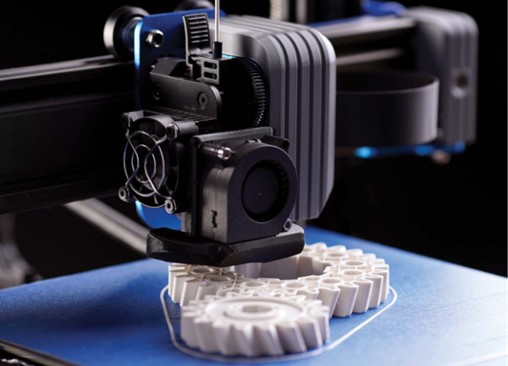
Figure 3. FDM 3D printing process.
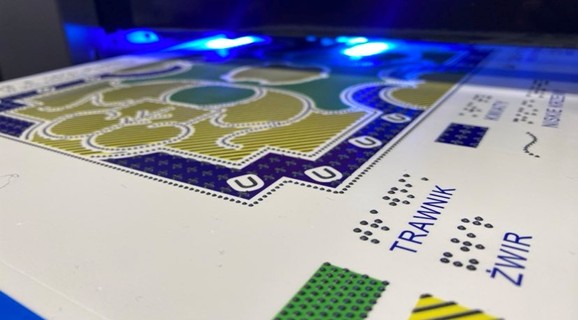
Figure 4. UV printing of a tactile map.
Other production methods, such as CNC milling and resin casting, may also be used in tactile cartography, particularly when durable, rigid, or highly precise tactile materials are required. These techniques are less commonly used for everyday production of tactile graphics, but they can be useful in specific cases, for example for producing durable map elements, transparent tactile materials, or moulds for further reproduction. The literature also points to the growing importance of multisensory and interactive tactile materials. Kuczyńska-Kwapisz and Śmiechowska-Petrovskij (2017) emphasize the role of spatial orientation and mobility strategies in the education and everyday functioning of people with visual impairments. Barvir, Vondráková, and Brus (2025) further show that tactile graphics can be enriched with accessible media, including audio descriptions, interactive points, QR codes, NFC tags, or other forms of digital feedback. These solutions allow more information to be communicated without overloading the tactile surface of the map. At the same time, every production technique has limitations. FDM printing may produce visible layers and rough surfaces, which can affect tactile legibility. Resin-based techniques offer high resolution but require skilled operators. UV printing provides high detail and colour quality, but it remains a 2.5D technique and is not suitable for all types of relief models. CNC milling and resin casting can produce durable and precise materials, but they require specialized equipment, qualified operators, and longer preparation time. For this reason, occupational health and safety requirements should be considered whenever tactile maps are produced using photopolymers, resins, milling, high-temperature processes, or electrically powered heating devices. The main strengths and limitations of selected production techniques can also be compared in terms of cost, durability, production complexity, versatility, and user evaluation. Such a comparison shows that each method offers a different balance between technical requirements, production efficiency, tactile quality, and practical applicability. Comparative table of tactile map production techniques, based on Wabiński et al., 2025.
| Technique | Cost | Durability | Complexity | Versatility¹ | User Evaluation |
| Manual techniques | Low | Low | Low | High | n/a |
| Thermoforming | High | High | High | Medium | n/a |
| Swell paper | Low | Medium | Low | High | Low |
| TactPlus | Medium | Low | Low | High | Very low |
| Braille printers | Low | Low | Low | High | Very low |
| 3D printing: FDM | Medium | Medium | Medium | Medium | Medium |
| 3D printing: SLA | Medium | Medium | High | Medium | High |
| 3D printing: SLS | High | High | High | Low | High |
| UV printing | Medium | Medium | Medium | High | n/a |
| CNC milling | High | High | High | Medium | High |
| Resin casting | High | Medium | High | Medium | Very high |
1 Understood as the possibility of producing hybrid tactile maps with both tactile and visual content. The comparison confirms that tactile map production techniques should not be treated as better or worse in a universal sense. Techniques with low cost and low complexity, such as manual methods, swell paper, or braille printers, may be suitable for simple educational materials, prototypes, and small-scale applications. However, they often provide lower durability, limited detail reproduction, or reduced user evaluation. More technologically advanced methods, such as SLA, SLS, CNC milling, or resin casting, may offer higher precision, durability, or tactile quality, but they are usually associated with higher costs, greater production complexity, and the need for specialized equipment. The choice of production technique should therefore depend on the intended purpose of the map, the expected number of copies, the required level of tactile and visual detail, the available budget, the durability requirements, and the needs of the target users. In practice, the most appropriate solution is often not the most advanced technology, but the one that provides the best balance between readability, comfort of use, production feasibility, and accessibility of the final tactile material This text provides only a brief introduction to the topic. A more detailed discussion of tactile map production techniques, including practical guidance on file preparation, printing, and post-processing, will be provided in Module 7 of the T-rep training materials: Tactile Maps Production Using Selected Techniques.
References
- Barvir, R., Vondráková, A., & Brus, J. (2025). Accessible media. In V. Van Altena & J. Wabiński (Eds.), Tactile mapping: Cartography for people with visual impairments (pp. 205–224). Esri Press.
- de Sena, C. C. R. G., & do Carmo, W. R. (2025). Learning geogrpahy when you’re blind. In V. Van Altena & J. Wabiński (Eds.), Tactile mapping: Cartography for people with visual impairments2 (pp. 155–170). Esri Press.
- Hashimoto, T., & Watanabe, T. (2016). Expansion characteristic of tactile symbols on swell paper: Effects of heat setting, position and area of tactile symbols. Lecture Notes in Computer Science (Including Subseries Lecture Notes in Artificial Intelligence and Lecture Notes in Bioinformatics), 9759(July), 69–76. https://doi.org/10.1007/978-3-319-41267-2_10
- Kuczyńska-Kwapisz, J., & Śmiechowska-Petrovskij, E. (2017). Orientacja przestrzenna i poruszanie się osób z niepełnosprawnością narządu wzroku. Współczesne techniki, narzędzia i strategie nauczania. Wydawnictwo Naukowe UKSW.
- van Altena, V., & Wabiński, J. (2025). Tactile mapping: Cartography for people with visual impairments. Esri Press.
- Wabiński, J., Mościcka, A., & Touya, G. (2022). Tactile maps design guidelines standardization: literature and best practices review. The Cartographic Journal. https://doi.org/10.1080/00087041.2022.2097760
- Wabiński, J., Mościcka, A., & Śmiechowska-Petrovskij, E. (2025). Comparative evaluation of production techniques for tactile map rendering. IEEE Transactions on Haptics, 19(1), 54–66. https://doi.org/10.1109/TOH.2025.3647374